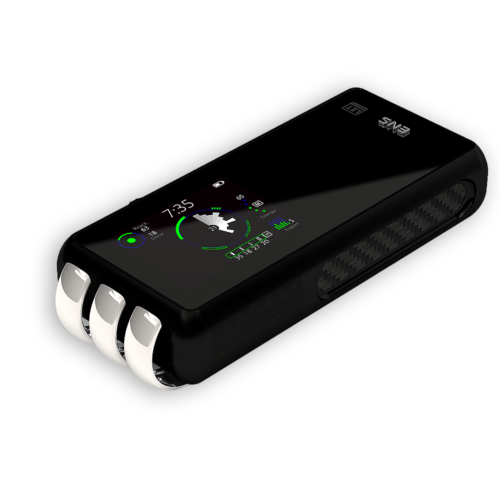
In order to give cosmonauts what they needed in space, a universal Personal Health Assistant, a different approach was required. It came from a humble awareness that no matter how hard we try, the human mind will never be able to grasp the complexity of the inner workings of a human body – hence, all our attempts to “diagnose” a disease will always be to some degree a guesswork and, therefore, will always leave some room for mistakes. The only way to avoid that is to give control over therapy to the only entity that knows exactly what’s going on and has a plan how to fix it – the body itself.
That’s how the ADAPTIVE electrical stimulation was born – and SCENAR as the first implementation of it.
SCENAR is an acronym, which stands for Self-Controlled Energo-Neuro Adaptive Regulation (Regulator).
SCENAR had two unique and distinctive features that set it apart from any other electrical stimulator.
• The first feature is the SHAPE of SCENAR impulses that resembles the shape of natural neuro-impulses – the signals that our nerves use to transmit information and communicate. The body, therefore, recognizes SCENAR impulses as something familiar and enters into a “dialog” with the device.
• The second distinctive feature of SCENAR is its ability to constantly adapt to the body by dynamically changing its signals in accordance with the FEEDBACK the device receives from the body. The feedback is read through the spontaneous changes in the electrical resistance of the skin (impedance) when the body responds to stimulation and does not involve any conscious efforts. The device signals will be changing as long as the body changes the local impedance and continues the “dialog”, which solves the problem of the body getting used to the stimulation and developing tolerance.
The adaptability of the SCENAR made it operate similarly to the living systems that adapt to their environment via constantly functioning feedback loops. When connected to the body, the SCENAR device became “an electronic mirror”, another dynamic system the body could check and balance itself against. That was a know-how that dramatically enhanced the body’s ability to heal itself (prompting the “Star Trek healing device” analogy) and that more than three decades ago only the SCENAR technology could provide.
SCENAR was a very effective treatment technology, which, however, in its first implementation (SCENARs of the first generation) had a few flaws.
SCENAR is a method of the “big stimulus”. In the first generation, SCENAR devices the acting impulse is artificially increased mimicking the pain impulse, in order to attract the body’s attention to the diseased part. In a way, SCENAR is a “pain amplifier” that elicits the amplified restorative reaction of the body.
This approach of “big stimuli” is rather inaccurate and requires complicated protocols in order to determine the precise location of the stimulus application, which limits the SCENAR technology‘s therapeutic potential. At the same time, SCENAR today remains the best method of natural pain relief.
SCENAR is the technology of motivating the body
to fight disease by “adding to pain”.
MORE on What Is SCENAR and How SCENAR Works – CLICK HERE

 Pain management with electrical current is well known in medicine. Non-invasive low-frequency electro-stimulators TENS (which stands for Transcutaneous Electrical Nerve Stimulation) are routinely used in many medical practices and home care for temporary pain relief.